Two-Term Governorship for Jechira Not Negotiable- Kunav Governorship Aspirants
 Tamenor Kwaghzer
Feb 9, 2026 06:23
721
0
Tamenor Kwaghzer
Feb 9, 2026 06:23
721
0
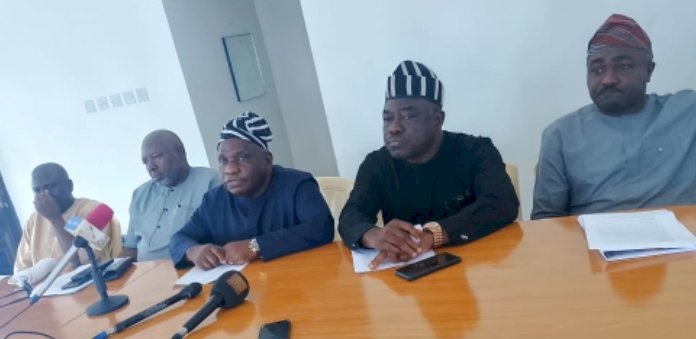
As Benue State commemorates its fiftieth anniversary, a group of governorship aspirants from the Kunav geopolitical axis has joined other indigenes in celebrating the milestone while reflecting on the state’s political future.
The aspirants, Professors Dennis Ityavyar and Paul Angya, ESV Godwin Ityoachimin, Rt. Hon. Dominic Terkaa Ucha and Hon. Joseph Waya, briefed journalists in Makurdi. Although Professor Terhemba Shija’s name appeared on the press statement, he was not present at the briefing.
They stated: “We take this solemn moment not merely to commemorate a historical milestone, but to reflect deeply on the state of our development, our security and our collective future.”
The group said the responsibility to speak truthfully was not only moral but also constitutional, stressing that unwillingness to speak out against actions that undermine democratic values amounted to complicity.
The joint Kunav aspirants explained that since the return of democracy in 1999, every geopolitical bloc in Benue State had enjoyed two terms, eight years, in office as governor. They warned that forcing the Jechira bloc out after a single term, based on allegations of poor governance against the incumbent Governor, Rev. Fr. Hyacinth Alia, would violate the established political culture of equitable rotation of power in the state.
They noted that the zoning arrangement for the governorship had been systematic, adding that no geopolitical bloc had served less than two terms. According to them, allowing Jechira to govern for only one term would amount to injustice.
To illustrate their argument, the aspirants likened the situation to a football match in which an underperforming player is substituted mid-game. They explained that such a substitution strengthens the team without abandoning the match or changing the field of play.
They argued that replacing an underperforming governor within the same zoning arrangement does not require dismantling the existing rotation formula, warning that doing otherwise would deny the Jechira people their right to eight years of political leadership.
Against this backdrop, the group alleged that Governor Alia, a Jechira indigene from Vandeikya Local Government Area, had failed to satisfactorily discharge the leadership responsibilities of his office. They claimed this failure had caused indigenes from other parts of the state to lose confidence in Jechira, particularly the Kunav axis, which some now perceive as untrustworthy.
However, amid the accusations, the aspirants maintained that “the people of Vandeikya remain among the best to be trusted with leadership responsibility.” They asserted that any of them could perform better than Governor Alia, explaining that this was why they were calling for his substitution, not the abandonment of Jechira’s turn.
Citing education as one area of alleged failure, the coalition criticised Governor Alia’s decision to establish the Benue State University of Agriculture, Science and Technology in his hometown, Ihugh, describing it as serving personal rather than public interest.
They contrasted this with the late Rev. Fr. Moses Orshio Adasu, a former governor from Konshisha Local Government Area, who established Benue State University in Makurdi rather than in his hometown, Awajir. The aspirants questioned why Governor Alia chose to locate the new university in Ihugh, arguing that the decision could alienate other parts of the state.
While acknowledging the potential benefits of the new university to the Benue child, the group expressed concern that the institution’s fees were affordable to only a few. They lamented that amid rising poverty, many parents were struggling to pay even basic examination registration fees, let alone university tuition.
They noted that while average parents could afford tuition at Moses Orshio Adasu University, Makurdi, they could not do so at the Ihugh institution. They further questioned why the new state-owned university charged about ₦650,000 as tuition when private universities in the state charged between ₦300,000 and ₦400,000.
The aspirants stressed that education, next to agriculture, gave Benue State a comparative advantage and should be promoted, warning that the commercialization of education in public institutions must be discouraged.
They urged Governor Alia to urgently address the disparities between the two state-owned universities to ensure equal access to education.
On security, the aspirants declared: “Nowhere is leadership failure more evident than in the growing insecurity that continues to claim innocent lives across the state.” They cited Sections 14(2)(b), 215(4) and 5(2) of the 1999 Constitution, which establish that the security and welfare of the people are the primary purpose of government and that the governor is the chief security officer of the state.
They referenced recurring attacks on rural communities, including the recent killings in Kwande Local Government Area, where armed herders reportedly invaded markets and murdered innocent citizens.
The aspirants accused Governor Alia of inaction despite preliminary reports linking the Kwande attack to herder-farmer conflicts, illegal mining and armed incursions, issues they said required proactive rather than reactive leadership.
They also cited repeated attacks in Guma, Logo, Makurdi, Apa and Ukum, warning that Benue’s security situation was deteriorating rather than improving.
According to them, “When communities are repeatedly attacked without decisive, preventive intervention, constitutional duties remain unfulfilled.”
On another front, the group cited Sections 38, 39 and 40 of the Constitution, which guarantee freedoms of thought, religion, expression and association. They alleged that recent statements by the Governor and the Speaker of the Benue State House of Assembly appeared to encourage hostility toward dissenting voices and religious institutions.
They described such statements as morally troubling and contrary to democratic principles, insisting that leadership must protect, not threaten, constitutional freedoms. Consequently, they called on the Inspector-General of Police, the DSS and other security agencies to take note and act appropriately.
The aspirants concluded: “Our intention today is not to attack personalities, but to defend constitutional values and the future of Benue State.”